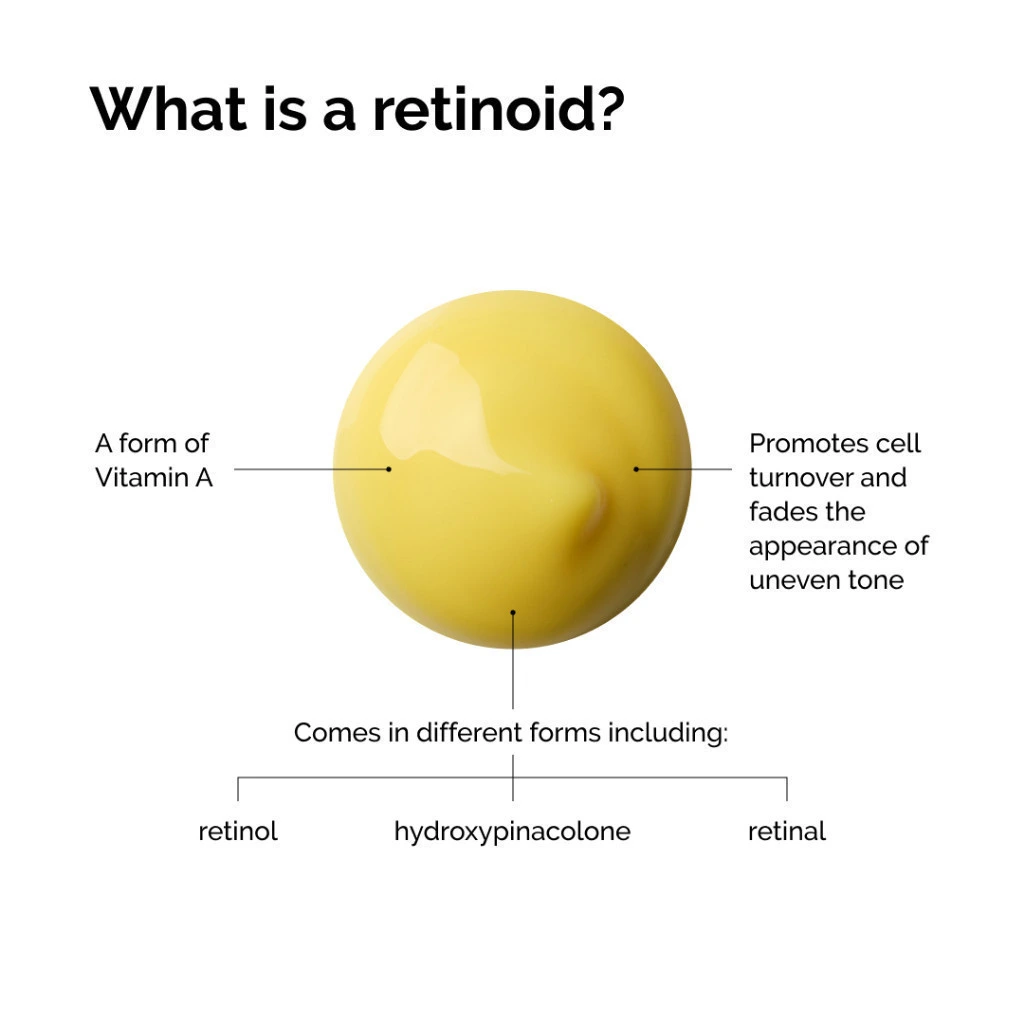
When it comes to anti-aging skincare, the Vitamin A family (Retinoids) is without a doubt the “gold standard.” It is the most clinically validated class of ingredients that dermatologists recommend to fight wrinkles, fine lines, and uneven texture. Yet, with a growing number of products featuring Retinol and Retinaldehyde (Retinal) , a common dilemma emerges: what’s the real difference, and which one deserves a spot in your routine?
The quick answer is that Retinal is the faster-acting, multitasking powerhouse and Retinol is the tried-and-true classic. They are two sides of the same coin, each with unique qualities, yet neither is intrinsically better. This blog will break down their science, benefits, product formats, and brand examples to help you make the best choice for your skin.
The Conversion Ladder: Why It Matters
To understand their differences, we must first look at how they work. The active version of retinoic acid, which attaches to skin cell receptors, is the “star” molecule that actually changes skin. However, retinoic acid is only available with a prescription (e.g., Tretinoin) because it is strong but extremely irritating when applied directly.
Precursor molecules used in over-the-counter (OTC) retinoids must undergo a number of transformations to become retinoic acid. The shorter the conversion path, the faster and more potent the effect, but also the higher the potential for irritation.
Here is the conversion hierarchy:
Retinyl Esters → Retinol → Retinaldehyde → Retinoic Acid (Active)
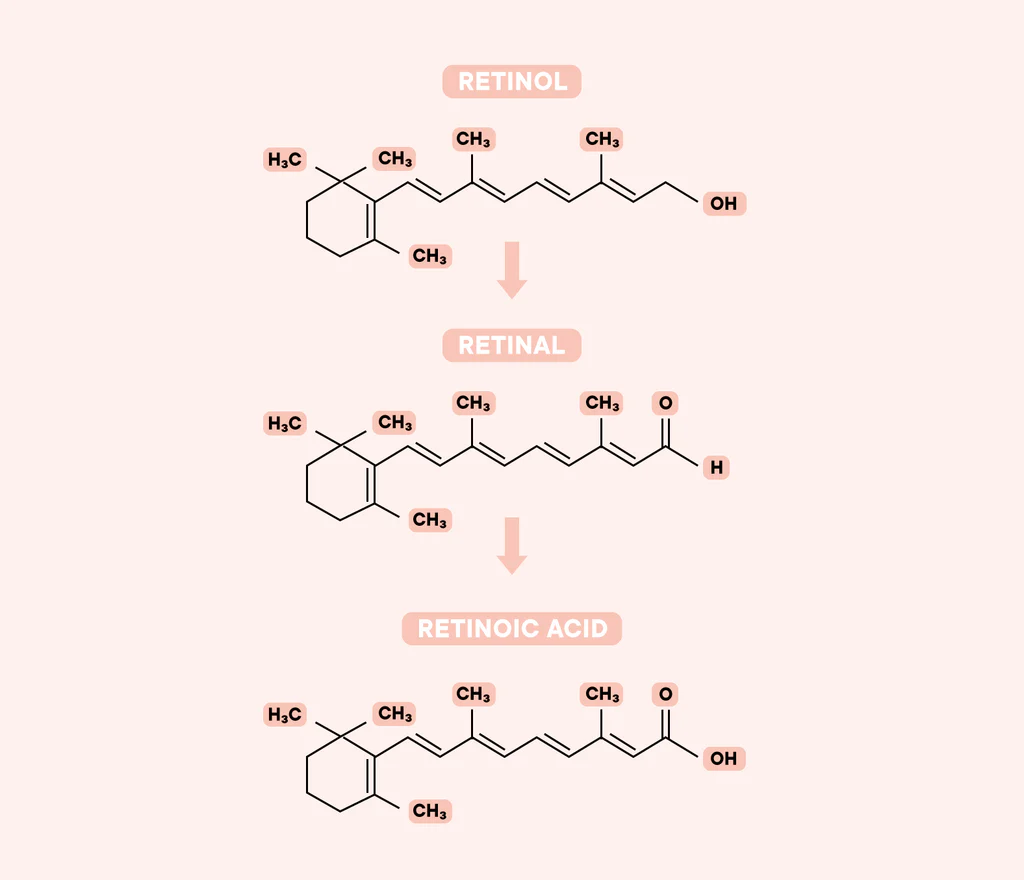
| Molecule | Steps to Retinoic Acid | Relative Potency | Key Characteristic |
| Retinyl Esters | 3 Steps | Low | Gentlest, best for beginners or sensitive skin. |
| Retinol | 2 Steps | Moderate | The classic OTC workhorse, balancing efficacy and tolerability. |
| Retinaldehyde (Retinal) | 1 Step | High | One-step conversion, closest OTC option to prescription-strength. |
| Retinoic Acid | 0 Steps (Active) | Very High | The gold standard, but requires a prescription due to high irritation. |
Fewer conversion steps mean faster, more potent results—but with higher irritation potential.
Retinol: The Trusted Workhorse
Retinol has been the cornerstone of OTC anti-aging for decades. A built-in “time-release” mechanism is created by the two conversion processes (Retinol → Retinal → Retinoic Acid). Most dermatologists recommend it when initiating a patient on a retinoid since it is more stable and far less irritating than its more powerful cousins.
Key Benefits of Retinol
- Cell Turnover: Accelerates the shedding of dead skin cells, revealing fresher, smoother skin.
- Collagen Stimulation: Reduces the appearance of fine lines and wrinkles over time.
- Even Skin Tone: Fades hyperpigmentation and sunspots.
- Acne Control: Helps clear clogged pores, preventing breakouts.
Clinical Evidence for Retinol
Retinol effectively reduces fine wrinkles when compared to a placebo, according to a 2025 network meta-analysis of 23 randomized controlled trials with 3,905 participants published in Scientific Reports (Odds Ratio 14.10, P < 0.0001). ” Among all the compounds evaluated, retinol consistently ranked as the most effective treatment for coarse wrinkles, showing greater cumulative probability in lowering the appearance of deep wrinkles. Retinol also showed considerable efficacy for hyperpigmentation (OR 2.03, P = 0.0089).
Spierings (2021) conducted a systematic review of OTC retinol trials and found that although five out of nine double-blind, vehicle-controlled trials had positive results for fine lines, these studies had significant methodological flaws, raising doubts about the validity of some positive findings. This emphasizes how crucial it is to select carefully designed, clinically verified products.
Typical Products and Strengthens
Retinol is found in a wide range of serums, creams, and oils, typically in concentrations from 0.01% to 1%. It’s often formulated with soothing ingredients like ceramides, hyaluronic acid, or niacinamide to buffer potential irritation.
Retinal (Retinaldehyde): The Potent One-Step Solution
Retinaldehyde, often marketed simply as Retinal, is the direct precursor to Retinoic Acid. It requires just a single enzymatic conversion step. Research from Dermatology and Therapy (2023) indicates that RAL is converted to RA at least 11 times faster than retinol, making it significantly more bioavailable. It’s also estimated to be approximately 3-fold more biologically active than retinol. This means you get faster, more visible results.
Unique Benefits of Retinal
- Faster Results: Compared to retinol, customers frequently see improvements in skin tone and texture more immediately due to its one-step conversion.
- Anti-Bacterial Action: Unlike retinol, retinaldehyde has a direct antibacterial effect against Cutibacterium acnes, the bacteria associated with acne.
- Superior Efficacy: Provides results that closely mirror prescription retinoids but with a better tolerability profile.
Clinical Evidence for Retinal
MLV-RAL (0.05%/0.1%) and retinol (0.05%/0.1%) were compared over eight weeks in a randomized, investigator-blind, split-face study (Kim et al., 2021) with 23 Korean volunteers. Both sides saw significant improvements in all objective metrics, including wrinkle depth; however, the MLV-RAL-treated side outperformed the retinol-treated side in objective assessments, and no adverse effects were noted.
A 2023 open-label clinical study demonstrated that a formulation containing 0.1% retinal, combined with bakuchiol and other anti-aging ingredients, produced statistically significant improvements within 28 days: skin firmness +5.6%, skin elasticity +13.9%, wrinkle count -43.2%, and skin tone homogeneity +7.0%. “Notably, crow’s feet wrinkles were significantly reduced in the majority of subjects, and the formulation was very well tolerated.”
Further highlighting retinaldehyde’s special antibacterial qualities, a comparative analysis published in the Polish Journal of Cosmetology (2025) found that it functions more quickly and efficiently at much lower concentrations while retaining an ideal tolerance profile.
Typical Products and Strengths
Concentrations of retinal typically range from 0.05% to 0.1%. It needs more sophisticated encapsulating technique to guarantee the molecule reaches the skin undamaged because it is less stable than retinol.
Head-to-Head Comparison: Retinol vs. Retinal
| Feature | Retinol | Retinal (Retinaldehyde) |
| Conversion Steps | 2 Steps | 1 Step |
| Potency | Moderate | High (Approx. 3x more potent than Retinol) |
| Conversion Speed | Slower | Faster (At least 11x faster conversion to RA) |
| Speed of Visible Results | Slower (8-12+ weeks) | Faster (Improvements seen in 4-8 weeks) |
| Irritation Potential | Low to Moderate | Moderate to High (but well-tolerated in studies) |
| Unique Benefit | Gentle, accessible, trusted | Anti-bacterial action against acne-causing bacteria |
| Skin Type | Best For Beginners, sensitive skin, maintenance | Experienced users, oily/acne-prone, seeking quick results |
Retinal works faster and 3x more potently than Retinol, but beginners should start with Retinol to build tolerance first.
Third-Party Endorsements & Clinical Insights
Dermatologist Recommendation:
Board-certified dermatologist Dr. Alexis Stephens says: “I frequently suggest Retinal to patients who have used retinol for years and wish to ‘level up’ without using a prescription. You get amazing results because it’s a one-step conversion. To build tolerance, I would still start with a low-concentration Retinol for a beginner.”
Renowned physician and skincare pioneer Dr. Zein Obagi promotes the use of retinaldehyde in his product lines, highlighting its special capacity to offer notable anti-aging benefits while being better tolerated than conventional prescription retinoids.
User Feedback:
Retinol Products User 1: My skin is substantially smoother now that I’ve been using it for six months. My fine wrinkles are clearly less noticeable, and it’s mild enough that I’ve never had peeling.
Retinol Products User 2: “Making the switch to Retinal changed everything.” In less than a month, I saw an improvement in the clarity of my skin. It cleared up my persistent breakouts on my chin and felt like a more effective version of my previous retinol.”
QiYuqin Retinal Anti-Aging & Renewal Line: Your Retinal Solution
QiYuqin Retinal Anti-Aging & Renewal Line is a comprehensive skincare solution that uses science-backed products to produce noticeable anti-aging results. If you’re ready to experience the power of Retinal, look no further.
Our Retinal-Powered Products
| Product | Key Ingredients | Main Benefits |
| Renewal Cleanser | Retinal + Purifying agents | Removes impurities & dullness, clarifies and purifies the skin |
| Renewal Face Serum | Retinal + Panthenol | Anti-aging, rapid skin smoothing, refines skin texture |
| Renewal Face Cream | Retinal + Moisturizing complex | Anti-aging, rapid skin smoothing, locks in hydration |
QiYuqin Renewal offers a complete Retinal regimen—cleanser, serum, and cream—for consistent, layered anti-aging benefits.
Why Choose QiYuqin Renewal Series?
- Strong Retinal Formula: Based on clinical research demonstrating that Retinal is at least 11 times faster in conversion to retinoic acid, our solutions contain stabilized Retinaldehyde, the one-step conversion powerhouse that produces faster, more noticeable benefits than regular retinol.
- Soothing & Gentle: Our products are appropriate for people switching from retinol to retinal since we combine retinal with panthenol and other calming substances to reduce discomfort. Clinical research has shown that panthenol, a provitamin B5, has skin-soothing and moisturizing qualities that strengthen the skin barrier and lessen the sensitivity that is frequently linked to retinoid use (Zasada & Budzisz, 2019). You can more comfortably enjoy the powerful anti-aging effects of Retinal thanks to our careful formulation.
- Complete Anti-Aging System: Unlike single-product solutions, our products offer a full regimen from cleanser to serum to cream, ensuring your skin receives consistent, layed retinal benefits at every step.
- Support for the Skin Barrier: Our formulas are made to provide active retinal while protecting the skin barrier, reducing the risk of “retinol uglies” and facilitating a smoother transition.
The Final Decision: How to Choose
Choosing between Retinol and Retinal ultimately depends on your skin’s experience, tolerance, and goals.
·
Choose Retinol if you are new to Vitamin A, have sensitive skin, or prefer a gentle, effective option for long-term maintenance.·
Choose Retinal if you have used retinol before with minimal irritation, want faster results, or are battling acne alongside aging.
Frequently Asked Questions
1. Can I use Retinol and Retinal together?
No. Using them together will only increase irritation without added benefit. Choose one that fits your experience level.
2. How often should I apply them?
Start with once or twice a week in the evening. Gradually increase to every other night, and then to nightly as your skin tolerates it.
3. What is the “retinol uglies”?
It refers to temporary irritation, peeling, and breakouts that can occur when starting a retinoid. This is a sign the skin is adjusting. For Retinal, this period can be more pronounced due to its higher potency.
4. Can I use them with other active ingredients?
Avoid using them with direct acids (like AHA/BHA) or Vitamin C in the same routine to prevent irritation. Use Vitamin C in the morning and Retinoids at night.
5. Which is better for acne-prone skin?
Retinal has a distinct advantage for acne-prone skin due to its proven antibacterial action against Cutibacterium acnes .
6. Can I use Retinal if I have sensitive skin?
Yes, but start with a lower concentration (0.01%–0.05%) and introduce it slowly.
Take the Next Step in Your Skincare Journey
The first step is to understand the science, but what really changes your skin is taking action.
For healthy, youthful-looking skin, both retinal and retinol have been shown to be useful by science. The “best” one is the one your skin loves and you use on a regular basis.
Are you prepared to meet your ideal match?
[Explore Our Handpicked Skincare Selection]
Discover our selection of dermatologist-approved Retinol and Retinal serums, along with individual consultations to help you. Don’t merely age; age gracefully and with the help of science.
References
Doat, G., Barry, C., & Bucay, V. (2025). Retinaldehyde cream with niacinamide, hyaluronic acid and thermal spring water with Aquaphilus dolomiae: A new anti-aging option. Journal of Clinical and Aesthetic Dermatology, Science of Skin Summit 2025.
Kim, J., Kim, J., Jongudomsombat, T., Kim, B. S. E., Suk, J., Lee, D., & Lee, J. H. (2021). The efficacy and safety of multilamellar vesicle containing retinaldehyde: A double-blinded, randomized, split-face controlled study. Journal of Cosmetic Dermatology, 20(9), 2874-2879.
Natural Retinol Analogs Potentiate the Effects of Retinal on Aged and Photodamaged Skin: Results from In Vitro to Clinical Studies. (2023). Dermatology and Therapy, 13, 2299-2317.
Spierings, N. M. K. (2021). Evidence for the Efficacy of Over-the-counter Vitamin A Cosmetic Products in the Improvement of Facial Skin Aging: A Systematic Review. Journal of Clinical and Aesthetic Dermatology.
Szczepanek, M., Gosztyła, M., & Koziej, M. (2025). Retinoids in cosmetology – a comparative analysis of the efficacy of retinol and retinal. Polish Journal of Cosmetology, 28(3), 84-89.
Topical interventions for facial photoaging: a network meta-analysis. (2025). Scientific Reports.
Zasada, M., & Budzisz, E. (2019). Retinoids: Active molecules influencing skin structure formation in cosmetic and dermatological treatments. Postępy Dermatologii i Alergologii, 36(4), 392-397.
Online Resources
American Academy of Dermatology (AAD) – Official website of the leading dermatological organization.
Visit: https://www.aad.org
National Institutes of Health (NIH) – U.S. government health research agency with extensive information on vitamins and skin health.
Visit: https://ods.od.nih.gov
PubMed – A free search engine for accessing scientific research papers and clinical studies.